
Here I am again at the Subaru dealer. My car was due for its checkup. I have about an hour to write something.
I will tell you about my encounter with a jellyfish.
As I was wading along the shore with my kayak at Miho, I noticed something moving on the surface of the sea. It looked like the Australian box jellyfish, Chironex fleckeri1, known for its lethal venom. Its name means “hand of death.”
But I am in Japan, not Australia.
Fascinated, I carefully scooped the jellyfish into my kayak and walked over to where an instructor was observing a group of people learning to windsurf. I showed him the jellyfish in my boat. He made an expression of disgust and said, “Itai! Itai! (痛い! 痛い!—“It hurts! It hurts!”) and then he said, “Dame! Dame! (だめ! だめ!),” which can mean various things in Japanese—most commonly “No! No!” In this case it meant something like, “Whatever you do, don’t touch that!” In normal conversation, dame is a strong expression used in dangerous situations such as when a child is about to pat a venomous snake on the head, or a newlywed is about to say the wrong thing to their mother-in-law.
As far as I could understand, the jellyfish I had in my boat was capable of giving a sting that would be painful, but was not likely to be fatal. I came to this conclusion because the instructor warned his students to be careful of jellyfish, but did not order them out of the water.
Later, it occurred to me that the instructor might not have liked his students, but I have decided that was being unfair.
I went back down the beach to the place I was before and released the jellyfish into the sea, since it probably wouldn’t kill anyone. Nearly everyone at the beach has their skin covered up to protect themselves from the sun.
And there are too many people around anyway.
I am not certain, but what I saw was probably a member of the group of box-shaped jellyfish known for being highly venomous. These jellyfish often have eyes, and the one I observed was obviously aware of my movements, as it kept swimming away from me. The picture below is quite similar to what I saw.2
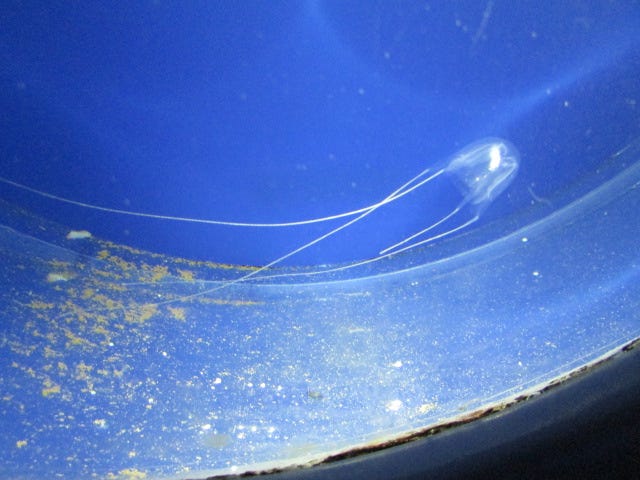
Scientists find jellyfish fascinating. They consist almost entirely of water. Some have eyes that allow them to move toward prey and avoid danger. Though jellyfish exhibit complex behavior, they don’t have brains.
Some are passive grazers, others track down their prey. Some are the size of a thimble, others can grow longer than a blue whale. Some cruise along the air-sea interface, others live thousands of meters beneath the surface.—National Geographic— “Jellyfish are finally giving up their secrets”
To be absolutely clear: Both scientists and jellyfish can have eyes. Jellyfish never have brains. Scientists always have brains, but sometimes act as if they don’t.
Jellyfish behavior is entirely encoded by their DNA. They operate mindlessly on autopilot, like many humans during an election year.
I usually have a GoPro camera with me. If I see another box jellyfish, I will try to capture it on video or in a photo and share it with you.
My car is all fixed up. Nothing major was wrong. Since I was told everything was already covered and it wouldn’t cost anything, I knew everything would be fine. They just added a couple of minor items that would somehow help the car. My bill was only about $300.
Sometimes, when you think everything is fine—that is when you get stung.
The Wikipedia entry for Chironex fleckeri is here: Chironex fleckeri
You can find this photograph, as well as more information, under the Wikipedia entry for Carybdea brevipedalia here: Carybdea brevipedalia
What is more dangerous, a jellyfish or a car dealership?
Fascinating! Good to hear from you John.