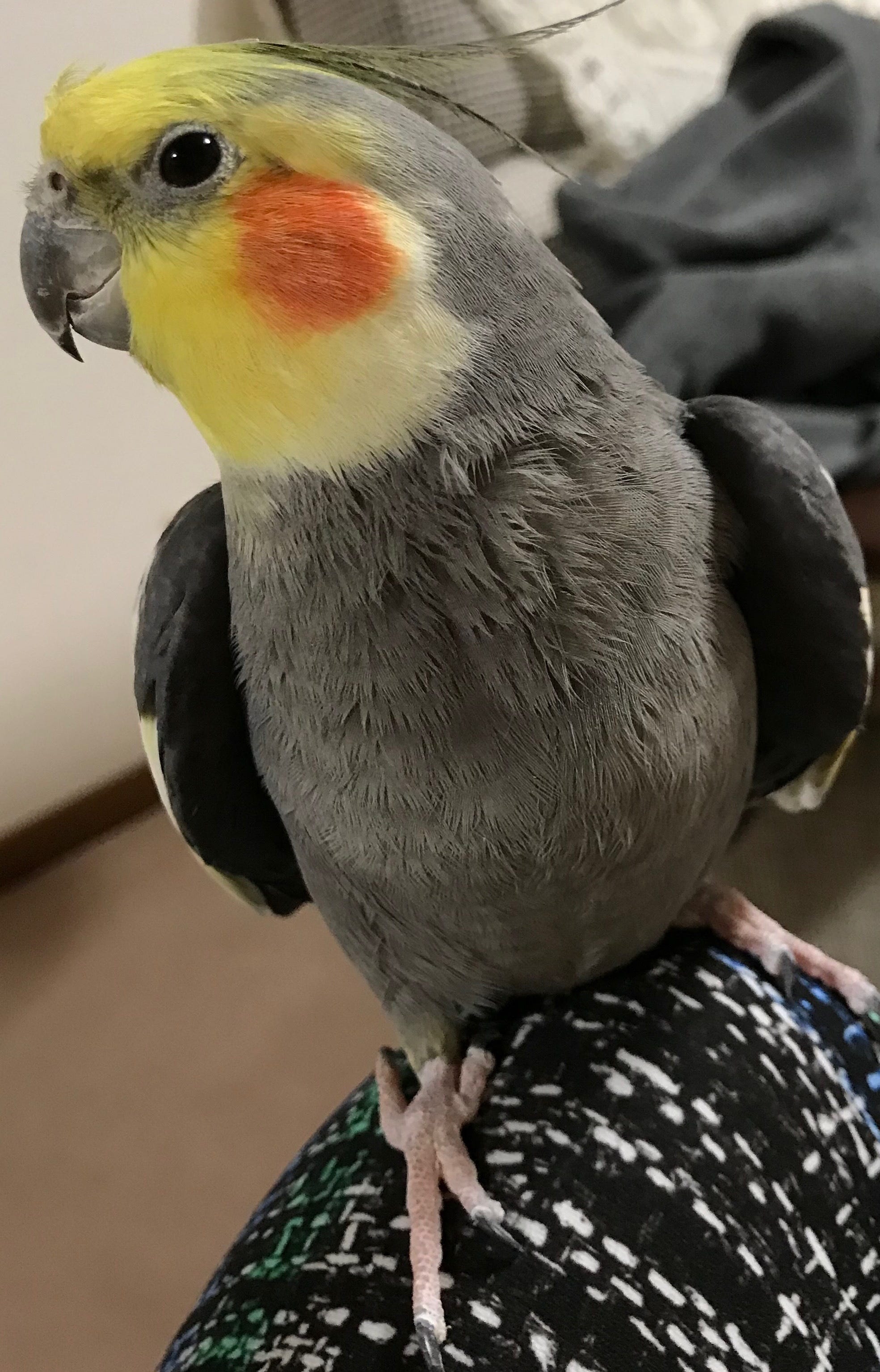
Our beautiful parakeet died.
The grief I experienced was so severe and unexpected that I want to try to process it by writing about it.
It was like being suddenly attacked by unseen assailants who came out of nowhere, armed with baseball bats to bludgeon me. I had no idea the death of a small bird weighing 100 grams would hurt so much.
Why the agonizing pain? Perhaps the difficulty of being accepted and loved by a different species takes you into a special zone. And when you suddenly lose this difficult, beautiful, and somehow primal space, it is devastating.
Before I continue, I need to tell you that I am a Canadian who has lived in Japan for about forty years. My Japanese wife and I live in Shizuoka City, about an hour from Tokyo by Shinkansen (bullet train). This story will make more sense if you know this.
I had known our parakeet for only a few years, but my wife had been with him for just over twenty, so she had many more memories of him than I did.
He was always addressed as “Peach” or just “P.” When I asked what his name was so I could address him correctly, my wife told me his real name was “Pinocchio,” a name apparently known only to close family.
But everyone called him Peach anyway.
In the evenings, my wife would sometimes gently massage Peach on the top of his head and around his cheeks. He made contented chirping noises while she did this.
Peach let my wife carry him from place to place while he perched on her shoulder. But he made it clear that I was to keep my distance unless I had food or water to offer him.
Peach disliked being alone, and when I returned home, I whistled and attempted to make parakeet-sounding noises that didn’t sound like a parakeet at all. He would sometimes respond with chirps and tweets, and allow me to greet him by pressing my fingernail against his cage so he could peck it. This interaction had recently become gentler. When I first met him, he sometimes drew blood if I wasn’t careful.
The reaction when my wife came home was quite different. Peach would become excited and call out to her from his cage, presumably saying, “Hey. Hey. Hey. Let me out of here!” But I am not sure, since I don’t speak Parakeet.
In the few days before he died, he seemed to be accepting my presence more. He would hop onto the table at breakfast time and come over to my plate, cocking his head and looking up at me as if to say, “Mind if I destroy your toast?” But I will never know, because I am not fluent in Parakeet.
But I know how delighted I was when this tiny bird finally walked over to my plate as if it was his plate, and seemed comfortable with me being close to him while he munched on my toast.
He was beginning to show signs of age—according to the vet, he was about 100 years old in human years, one of the oldest parakeets he had seen at his clinic.
Peach was having trouble walking, and his increasingly bad balance was affecting his ability to perch on the back of his favorite chair.
On the evening of September 16th, he suddenly had trouble breathing. At first it seemed minor, but it became clear that something was seriously wrong.
My wife lay beside Peach’s cage that night. He fought fiercely all through the night to breathe. In the morning, he was standing in his cage with his head thrown back as if he was trying to breathe with all his might.
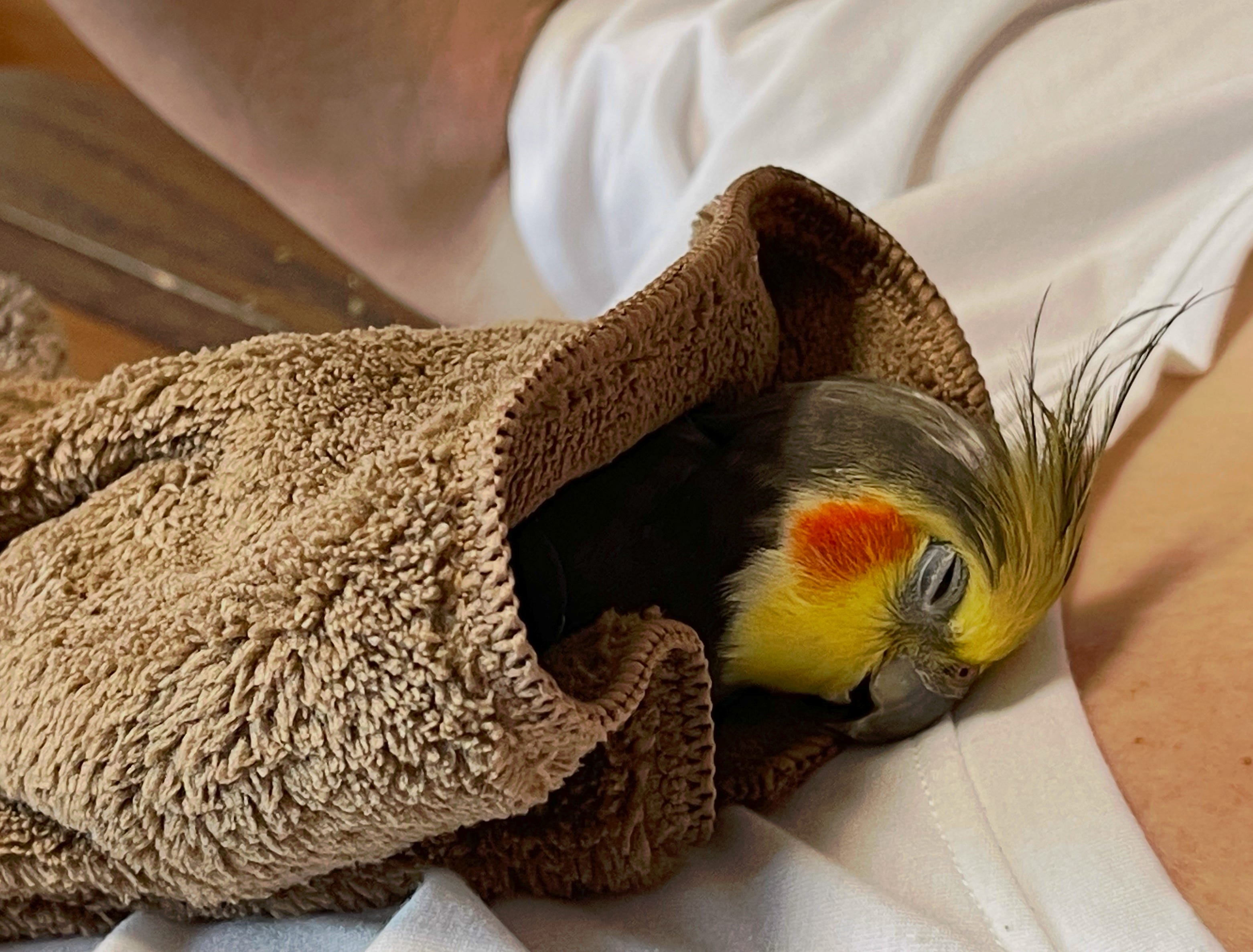
Realizing these were the last moments of his life, my wife gently wrapped Peach in a cloth and held him on her chest.
He left us just before nine o’clock in the morning, next to the human he loved most.
After Peach died, my wife called a cremation service for pets. I heard her on the phone attempting to get clear directions.
We visited the clinic that had been caring for Peach, so my wife could thank the staff. The vet was surprised that Peach had died so suddenly, since they had just given him a checkup a few days earlier.
We then set off to find the temple parking lot in Fujieda City where we were supposed to meet the crematory van. It was about forty minutes away by car.
After getting lost a few times, we finally arrived at the temple grounds at dusk, found the parking lot, and located the van. The attendant was very supportive and kind. She showed us how to prepare Peach for cremation. We were told to wait for about thirty minutes for the cremation to complete.
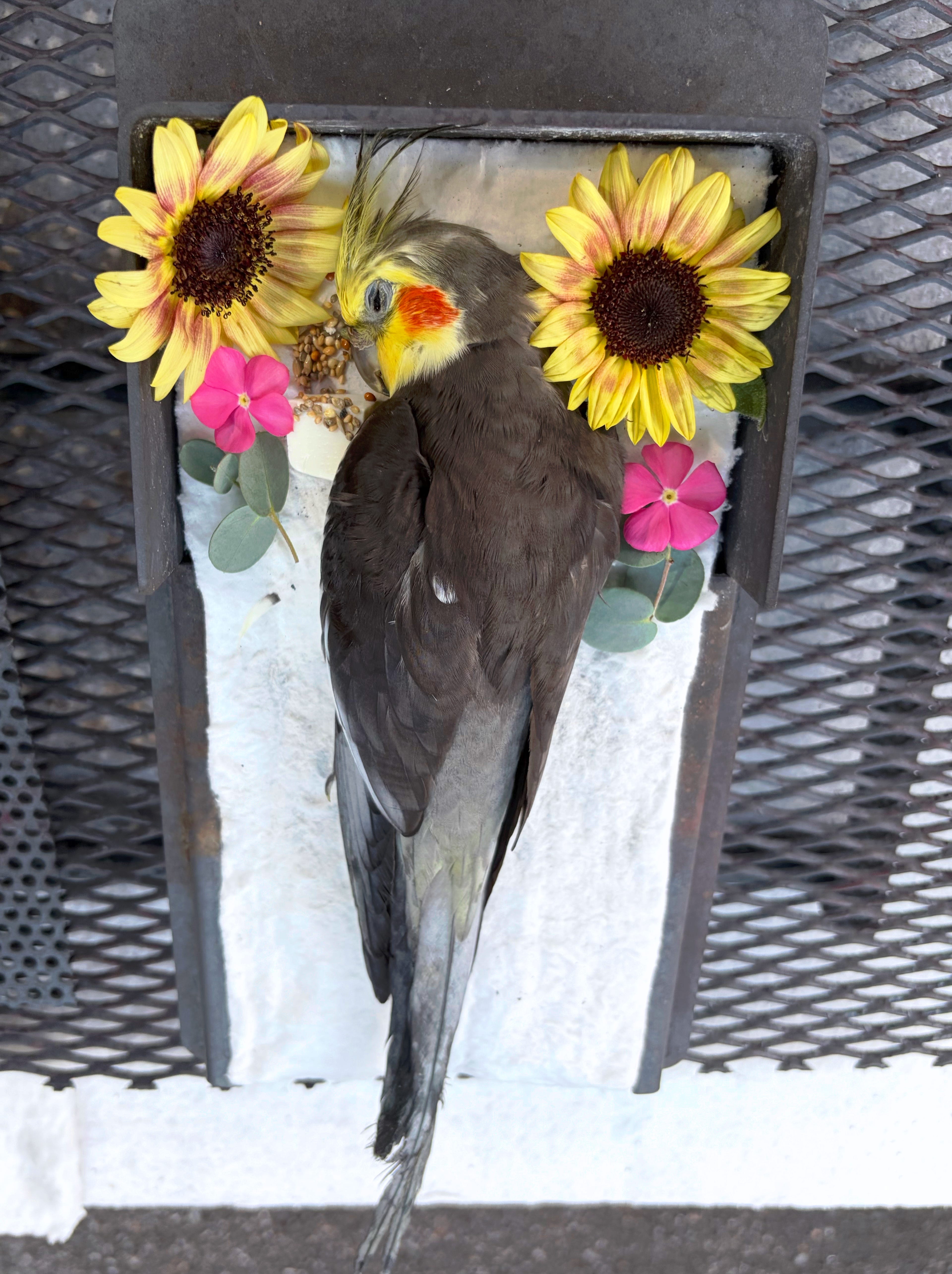
As Peach was being cremated, a few clouds started to gather. There was a single star in the sky. We decided to take a short stroll while we waited.
After we returned to the temple parking lot, I looked up and noticed a small, solitary bird on a wire overhead. The bird was about the same size as Peach, and seemed to be watching over us. After a few minutes, the bird flew up into the night sky as if it was trying to tell us everything was going to be alright.
“Don’t worry. Your little bird isn’t hurting anymore,” it seemed to say.
After Peach was cremated, we were handed chopsticks to place his bones in a small urn. The attendant then placed the urn in a fabric cover and presented it to us.
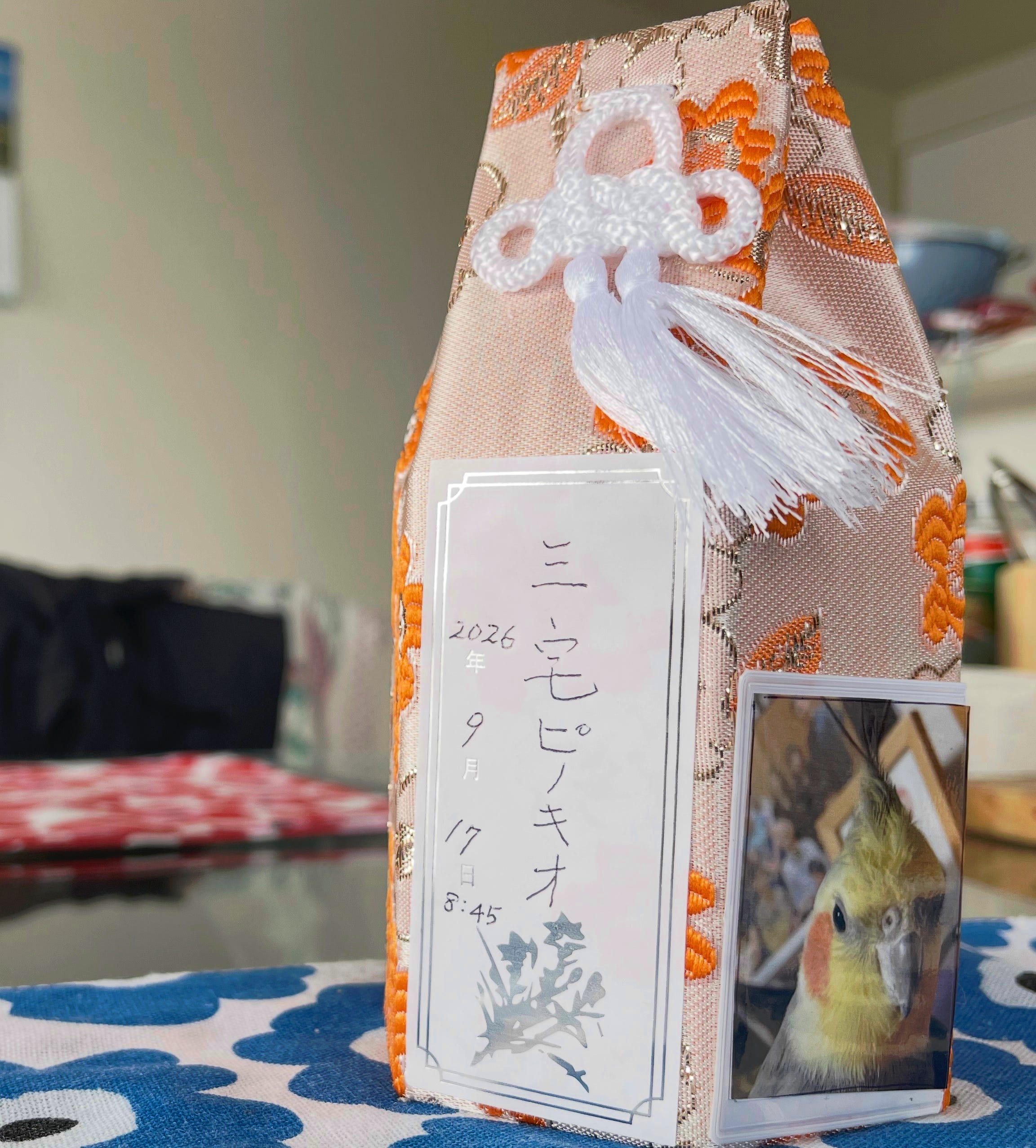
The cover displays Peach’s proper name 三宅 (Miyake)ピノキオ (Pinocchio) and his time of death. My wife’s surname “Miyake” means “three houses.” In Japan, the family name comes before the personal name.
We thanked the attendant and returned to Shizuoka City, stopping on the way to get some boxes of sushi for dinner.
At home, we had our sushi with some sake we had left in the fridge. We raised our cups and toasted our beloved Peach. My wife instructed me not to use the usual “kampai” 乾杯, a toast for celebration, but instead to use “kempai” 献杯, a toast to honor the deceased.
Then my wife and I quietly had our dinner together in our newly silent house.
I felt oddly at peace and terribly sad at the same time.
I hope our parakeet was happy living with us and that he struggled so hard to survive because he wanted to stay with us a little longer.
I hope so, Pinocchio; I really do.
We will miss you. And our home is horribly empty without you here.